
Jet skis vanish from trailers and dry storage every summer — here’s how GPS tracking gets them back
GPS tracker for jet ski: how to choose one that survives the water, the off-season, and theft
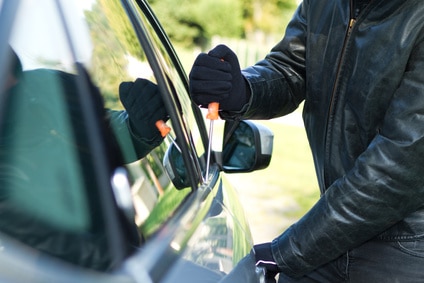
A jet ski is one of the easiest high-value toys to steal. It sits on a trailer, weighs little compared to a boat, and can be hooked up and towed away in the time it takes to grab a coffee. If yours disappears, the odds of getting it back come down to one thing: whether you can tell police exactly where it is. A GPS tracker for a jet ski gives you that answer, but only if it’s built for the realities of marine use, months of off-season storage, and thieves who know where to look.
This guide walks through what actually matters when you’re choosing a tracker for a personal watercraft (PWC), whether you own one ski or run a rental fleet.
Why jet skis need GPS tracking
Jet skis check every box a thief looks for. They’re valuable, portable, and easy to resell with filed-off hull numbers. A ski on a trailer in your driveway can be gone in minutes, and the same goes for units parked at a marina, stored in a shared facility, or left on a lift.
The risk doesn’t disappear in the winter. In fact, theft often peaks during storage and the off-season, when owners aren’t checking on their watercraft for weeks at a time. A ski can vanish in October and not be missed until spring. That’s the same pattern that makes off-season storage so risky for classic cars and snowmobiles, and the fix is the same: a tracker that’s still watching when you’re not.
Recovery rates improve dramatically when you can hand police a live location instead of a description. A tracker also protects resale value, since a documented anti-theft device makes a used ski more attractive, and many insurers offer lower premiums on watercraft fitted with GPS recovery hardware. That value applies whether you’re a weekend rider, a rental operator, or a marina manager responsible for other people’s equipment.
Features that matter most in a GPS tracker for a jet ski
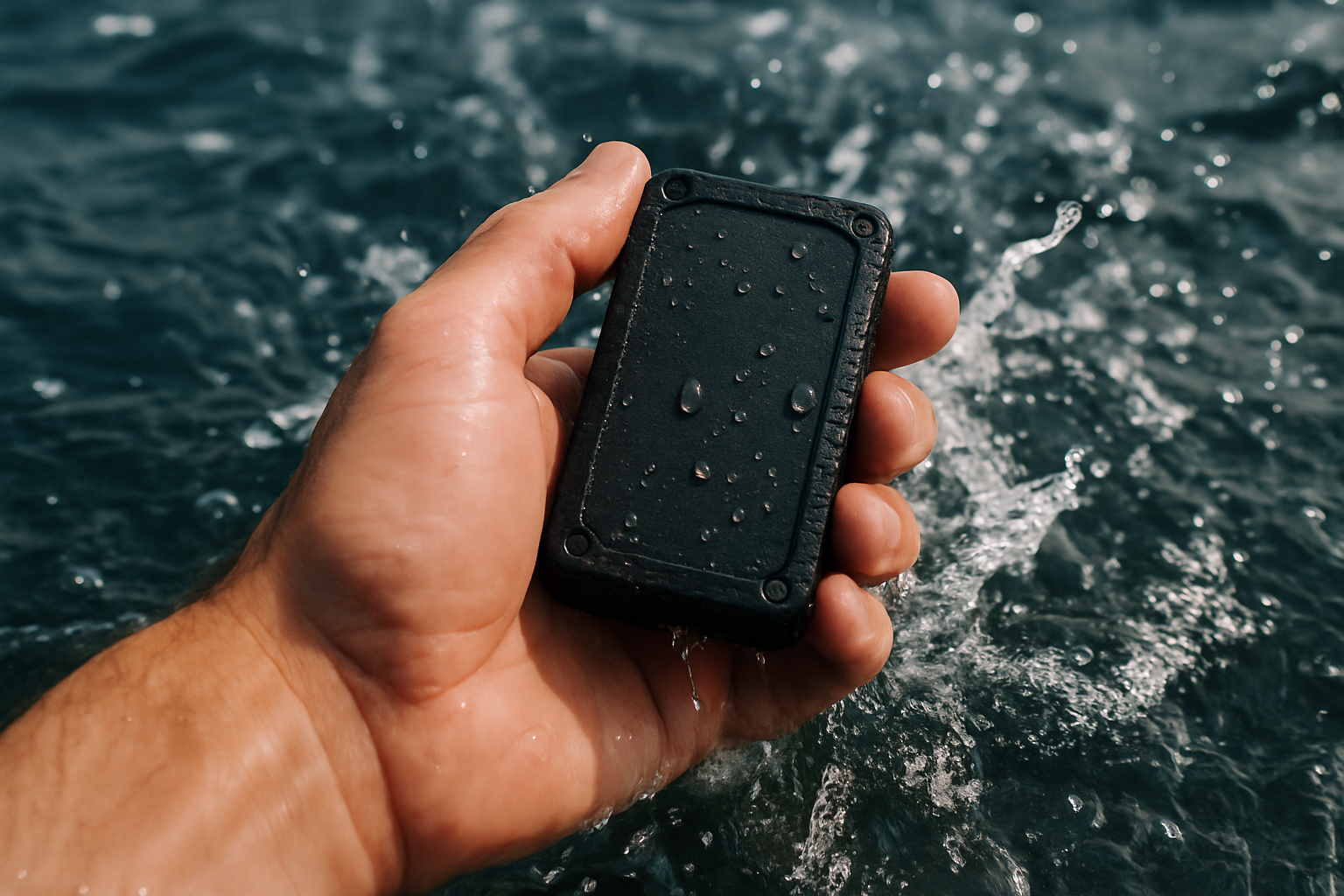
Not every tracker belongs on the water. The ones worth your money share five traits: marine-grade waterproofing, long battery life, a concealable size, real-time alerts, and geofencing. Each one maps directly to protecting the watercraft.
Waterproofing keeps the device alive in a wet, salty environment. Long battery life keeps it running through months of storage. A compact size lets you hide it where thieves won’t look. Real-time alerts tell you the moment the ski moves. Geofencing draws a boundary that triggers those alerts automatically.
Generic vehicle trackers fall short here. Many assume access to a 12-volt power source or expect a recharge every few weeks, and plenty are only splash-resistant. On a jet ski, that combination fails fast. Below, each feature in detail.
Waterproof rating and marine durability
The waterproof spec to look for is the IP (Ingress Protection) rating. The second digit covers water: IP67 means the device survives temporary submersion in up to a meter of water, while IP68 handles deeper, longer submersion. For marine use, treat IP67 as the minimum and lean toward IP68 if the tracker might sit in a compartment that takes on water.
A jet ski tracker faces more than the occasional splash. It deals with full humidity, spray, standing water in storage compartments, and salt, which corrodes electronics that aren’t properly sealed. A genuinely sealed housing and a wide temperature tolerance matter, because the device may bake in a sun-exposed hull in summer and freeze in unheated winter storage.
Watch the marketing language. “Water-resistant” is not the same as “waterproof.” A water-resistant device shrugs off rain; a waterproof one survives submersion. On a PWC, you want the second kind.
Battery life for seasonal watercraft
This is where most trackers designed for cars let jet ski owners down. A car gets driven and can power a hardwired tracker. A jet ski sits unused for months, so there’s no steady power source, and climbing into a stored hull to recharge a tracker mid-season isn’t realistic, especially when you shrink-wrap or cover it for winter.
That’s why battery life is the single most important spec for seasonal watercraft. A tracker with a battery rated for up to 10 years keeps working straight through the off-season, so it’s still reporting the day a thief shows up in February. A unit that needs recharging every few weeks is useless the moment you stop thinking about it.
Reporting frequency drives battery drain. A tracker that pings every few seconds burns power fast; one that reports periodically and wakes up on movement can stretch its battery for years. The best devices adjust automatically: quiet while the ski is parked, active the instant it moves. If you want to understand the broader trade-offs, our breakdown of hardwired versus battery-powered trackers covers which approach fits which asset. For a jet ski, a long-life battery unit almost always wins.
Size and concealed mounting on a small hull
A jet ski has far less hidden space than a car or truck. The tracker needs to be small enough to tuck into a tight compartment or alongside existing components without being obvious. A bulky device has nowhere to go and gets found immediately.
Concealment is the point. A tracker a thief can see is a tracker a thief can rip out and toss before driving off. The smaller and better-hidden the device, the longer it keeps transmitting after the ski is stolen.
There’s a balance to strike. GPS and cellular signals weaken when the device is buried under metal or dense material, so the hiding spot has to protect the tracker without blocking its signal. The next section covers specific placements.
Real-time alerts and geofencing
Real-time alerts turn a tracker from a recovery tool into a theft-prevention tool. The moment your ski moves off its spot or gets loaded onto a trailer, you get a notification on your phone, giving you a head start on the thief instead of discovering the loss days later.
Geofencing makes this automatic. You draw a virtual boundary around your home, your marina slip, or your storage facility, and the tracker alerts you if the ski crosses it. For a rental operation, the same feature flags a ski that strays outside the permitted riding area.
Once a theft is underway, live location tracking is what guides recovery. A real-time GPS tracker lets you follow the ski’s movement and relay its current position to police, which is far more actionable than a last-known location from hours ago.
Where to hide a GPS tracker on a jet ski

Placement decides whether your tracker survives a theft. The most common concealment spots on a PWC are the front storage compartment, the area under the seat, and the space near the electrical housing. Each offers cover, but each has trade-offs.
Keep the device away from large metal components and the engine block, which can block or weaken the signal. You want the tracker surrounded by plastic or open space rather than buried behind a metal firewall. The under-seat area often works well because it balances concealment with a clear path to the sky.
Mounting matters as much as location. Secure the tracker so it can’t shift, rattle loose, or slide into standing water in an open compartment. Marine-grade adhesive mounts or a sealed pouch wedged firmly in place both work, as long as the device stays dry and stable through rough rides and towing.
There’s a tension between accessibility and concealment. A tracker you can reach easily to recharge is also one a thief can reach. This is exactly where ultra-long battery life pays off: with a 10-year battery, you never need to retrieve the device for charging, so you can bury it in the hardest-to-reach, best-concealed spot and forget about it. The same logic drives the best concealment strategies for cars—the deeper you can hide it, the better it protects you.
Why encrypted location data matters
A GPS tracker records more than where your jet ski sits. Over time it builds a picture of where you launch, where you ride, and where you store your watercraft and its trailer. That’s sensitive information, and it deserves protection.
If that location data travels unencrypted, it can be intercepted or misused, potentially exposing your home address, your storage facility, and your routines to anyone who gets hold of it. The whole point of a security device is undermined if it quietly leaks your movements.
Encryption closes that gap by scrambling your location data so only you can read it. It’s the difference between a tracker that protects you and one that creates a new vulnerability. Most consumer devices—and even your phone—share location data more freely than owners realize. LoneStar Tracking encrypts all location data as standard, because a device meant to keep your watercraft safe shouldn’t put your privacy at risk.
Personal watercraft vs. rental fleet tracking
The right setup depends on how many skis you’re protecting.
For an individual owner, the model is simple: one device, one app, and alerts that go straight to your phone. You set a geofence around home or your slip, enable movement alerts, and leave it alone. The tracker’s job is theft protection and recovery, and that’s it.
Rental operators and marina managers need more. A fleet dashboard lets you monitor multiple units at once, see which skis are out and which are docked, and track usage across the operation. Geofencing keeps rental skis inside the authorized riding area and flags any unit that heads out of bounds or doesn’t return on schedule. These are the same capabilities that help equipment rental companies recover unreturned units and track utilization, applied to the water.
For marina managers, tracking also surfaces operational insight: which units see the most use, which are due for maintenance, and where idle inventory is sitting. If you’re scaling up, the broader principles of fleet GPS tracking carry over directly.
Cost and subscription considerations
Most GPS trackers follow a two-part pricing structure: the cost of the device plus a data or service plan that covers cellular connectivity and the app. The device is a one-time purchase; the plan is ongoing.
Before you buy, read the fine print. Check whether the subscription is monthly or annual, what it includes, and whether features like real-time tracking or geofencing cost extra. Confirm there are no activation fees or hidden charges, and find out what happens to the service if you stop paying.
Weigh the subscription against what you’re protecting. A modest monthly fee is trivial next to the cost of replacing a stolen jet ski, and it dramatically improves your odds of recovery. The math almost always favors having the tracker.
Be cautious with the cheapest options. A rock-bottom price usually means a shorter battery life and weaker waterproofing—the two specs that matter most for a seasonal watercraft. A tracker that dies in storage or corrodes after one salt-water season costs you more than it saves.
How to install and set up a tracker on your jet ski
Setup is straightforward and takes well under an hour.
- Choose the concealed location. Pick a spot with signal access and good cover, such as under the seat or in the front compartment, away from heavy metal.
- Secure the device. Mount it firmly so it won’t shift during rides or towing, and make sure it stays dry even if a little water enters the compartment.
- Activate and pair. Turn on the device, activate the service plan, and connect it to the companion app on your phone.
- Set geofences and alerts. Draw a boundary around your home, slip, or storage spot, and enable movement and tow-away notifications.
- Test before launch. Confirm the tracker reports its location accurately and that alerts fire when the ski moves, before it goes back in the water.
Run a quick test at the start of each season, too, so you know the device is reporting after months in storage.
How long should a jet ski GPS tracker’s battery last?
For a seasonal watercraft, aim for the longest battery life you can get. Trackers rated for up to 10 years are ideal because they survive the entire off-season without a recharge. Avoid devices that need charging every few weeks—they tend to be dead the moment you actually need them.
Will a GPS tracker survive being submerged or exposed to salt water?
A properly waterproof tracker will. Look for an IP67 rating at minimum, or IP68 for deeper submersion, along with a sealed housing built to resist salt corrosion. Avoid devices labeled only “water-resistant,” which handle splashes but not submersion.
Can a thief find and disable a hidden jet ski tracker?
A well-concealed, compact tracker is hard to find in the limited time a thief wants to spend on a job. The deeper you hide it, the better—and because a long-life battery means you never need to retrieve it for charging, you can place it somewhere nearly impossible to reach without disassembling the ski.
Do jet ski GPS trackers require a monthly subscription?
Most do, since the cellular connection and app service have an ongoing cost. Plans are usually modest and often available monthly or annually. Always confirm what’s included and watch for hidden fees before you buy.
How does geofencing help recover a stolen jet ski?
Geofencing creates a virtual boundary around your home, slip, or storage facility. The instant your ski crosses that line, you get an alert—often before the thief is far away. Combined with live location tracking, it lets you give police a current position instead of a guess.